-
Evaluate the following integrals:
\[\begin{align*} \int xe^xdx&=\int xd(e^x)=xe^x-\int e^xdx=xe^x-e^x+C \end{align*} \]
a. \(\displaystyle\int xe^xdx\)
This uses integration by partsb. \(\displaystyle\int\sin^4x\cos xdx\)
\[\begin{align*} \int\sin^4x\cos xdx=\int\sin^4xd(\sin x)=\int u^4du=\dfrac{1}{5}u^5+C=\dfrac{1}{5}\sin^5x+C \end{align*} \]
This uses \(u\)-sub by \(u=\sin x\)c. \(\displaystyle\int\ln xdx\)
\[\begin{align*} \int\ln xdx=x\ln x-\int\dfrac{1}{x}dx=x\ln x-x+C \end{align*} \]
This uses integration by partsd. \(\displaystyle\int\sin^2xdx\)
\[\begin{align*} \int\sin^2xdx&=\int\dfrac{1-\cos(2x)}{2}dx=\int\dfrac{1}{2}dx-\int\dfrac{\cos(2x)}{2}dx\\ &=\dfrac{1}{2}x-\dfrac{\sin(2x)}{4}+C \end{align*} \]
This uses the half angle formula \(\sin^2x=\dfrac{1-\cos(2x)}{2}\)e. \(\displaystyle\int\sqrt{1-x^2}dx\)
\[\begin{align*} \int\sqrt{1-x^2}dx&=\int\sqrt{1-\cos^2t}d(\cos t)=\int\sin t\cdot(\sin t)dt=-\int\sin^2tdt\\ &=-\dfrac{1}{2}t+\dfrac{\sin(2t)}{4}+C=-\dfrac{1}{2}\arccos(x)+\dfrac{\sin(2\arccos(x))}{4}+C \end{align*} \]
This uses trig-sub by \(x=\cos t\), so \(t=\arccos(x)\), and -
Parametrize the following curves:
\[\begin{cases} x=3\cos t \\ y=3\sin t \end{cases} \]
a. The circle centered at the origin with radius 3.for \(0\leq t\leq 2\pi\).
\[\begin{cases} x=1+2\cos t \\ y=2+2\sin t \end{cases} \]
b. The circle centered at \((1, 2)\) with radius 2.for \(0\leq t\leq 2\pi\). In general, a parametrization of the circle of radius \(r\) centered at \((a,b)\) could be
\[\begin{cases} x=a+r\cos t \\ y=b+r\sin t \end{cases} \]for \(0\leq t\leq 2\pi\).
\[\begin{cases} x=t \\ y=t^2 \end{cases} \]
c. The graph of the function \(y = x^2\).for \(-\infty<t<\infty\).
\[\begin{cases} x=2\cos t \\ y=3\sin t \end{cases} \]
d. The ellipse given by the equation \(\dfrac{x^2}{4} + \dfrac{y^2}{9} = 1\).for \(0\leq t\leq 2\pi\). In general, a parametrization of \(\dfrac{x^2}{a^2} + \dfrac{y^2}{b^2} = 1\) could be
\[\begin{cases} x=a\cos t \\ y=b\sin t \end{cases} \]for \(0\leq t\leq 2\pi\).
-
(\(\S11.1\), 20) Find an equation of the set of points twice as far from the origin as from the point \((-1, 1, 1)\). Show that the set of points is a sphere and find its center and radius.
Denote \(O=(0,0,0)\), \(P=(-1,1,1)\), and assume \(Q=(x,y,z)\) is a point in the set of points twice as far from the \(O\) as from the point \(P\), then we know that \(|OQ|=2|PQ|\), thus we get an equation
\[\sqrt{(x-0)^2+(y-0)^2+(z-0)^2}=2\sqrt{(x+1)^2+(y-1)^2+(z-1)^2} \]Square both sides we got
\[x^2+y^2+z^2=4\left[(x+1)^2+(y-1)^2+(z-1)^2\right] \]Expand the terms we have
\[x^2+y^2+z^2=4x^2+8x+4+4y^2-8y+4+4z^2-8z+4 \]Cancel \(x^2+y^2+z^2\) on both sides
\[0=3x^2+8x+4+3y^2-8y+4+3z^2-8z+4 \]Complete the squares we have
\[3\left(x+\frac{4}{3}\right)^2+3\left(y-\frac{4}{3}\right)^2+3\left(z-\frac{4}{3}\right)^2=3\cdot3\cdot\left(\frac{4}{3}\right)^2-3\cdot4=4 \]Finally divide 3 on both sides
\[\left(x+\frac{4}{3}\right)^2+\left(y-\frac{4}{3}\right)^2+\left(z-\frac{4}{3}\right)^2=\frac{4}{3} \]Recall that the equation of a sphere of radius \(r\) centered at \((x_0,y_0,z_0)\) is
\[(x-x_0)^2+(y-y_0)^2+(z-z_0)^2=r^2 \]So this set of points is the sphere of radius \(\sqrt{\dfrac{4}{3}}\) centered at \(\left(-\dfrac{4}{3},\dfrac{4}{3},\dfrac{4}{3}\right)\)
-
(\(\S11.1\), 22) Find the midpoint of the line segment joining the points \((3, 7, 11)\) and \((–9, 8, 31)\). Can you determine the coordinates of the two points that divide this segment into three equal parts?
Suppose \(P=(x_0,y_0,z_0)\) and \(Q=(x_1,y_1,z_1)\). The midpoint is of \(PQ\) is
\[\left(\dfrac{x_0+x_1}{2},\dfrac{y_0+y_1}{2},\dfrac{z_0+z_1}{2}\right) \]and the two points dividing \(PQ\) into three equal parts are
\[\left(\dfrac{2x_0+x_1}{3},\dfrac{2y_0+y_1}{3},\dfrac{2z_0+z_1}{3}\right),\quad\left(\dfrac{x_0+2x_1}{3},\dfrac{y_0+2y_1}{3},\dfrac{z_0+2z_1}{3}\right) \]Therefore, the mid point of \((3, 7, 11)\) and \((–9, 8, 31)\) is
\[\left(\dfrac{3+(-9)}{2},\dfrac{7+8}{2},\dfrac{11+31}{2}\right)=\left(-3,\dfrac{15}{2},21\right) \]and the two thrid points are
\[\left(\dfrac{2\cdot3+(-9)}{3},\dfrac{2\cdot7+81}{3},\dfrac{2\cdot11+31}{3}\right)=\left(-1,\dfrac{22}{3},\dfrac{53}{3}\right) \] \[\left(\dfrac{3+2\cdot(-9)}{3},\dfrac{7+2\cdot8}{3},\dfrac{11+2\cdot31}{3}\right)=\left(-5,\dfrac{23}{3},\dfrac{73}{3}\right) \]
-
Suppose \(P=(0,-1,3)\), \(Q=(\sqrt{2},0,2)\)
\[\overrightarrow{PQ} = (\sqrt2-0)\mathbf i+(0-(-1))\mathbf j+(2-3)\mathbf k=\sqrt2\mathbf i+\mathbf j-\mathbf k \]
a. Write \(\overrightarrow{PQ}\) as a vector in the form \(a\mathbf i+b\mathbf j+c\mathbf k\).b. Find the length of the vector \(\overrightarrow{PQ}\).
\[\|\overrightarrow{PQ}\|=\sqrt{(\sqrt2)^2+1^2+(-1)^2}=\sqrt4=2 \]c. Find the unit vector having the same direction as \(\overrightarrow{PQ}\).
\[\mathbf u = \dfrac{\overrightarrow{PQ}}{\|\overrightarrow{PQ}\|}=\dfrac{\sqrt2\mathbf i+\mathbf j-\mathbf k}{2}=\dfrac{1}{\sqrt2}\mathbf i+\dfrac{1}{2}\mathbf j-\dfrac{1}{2}\mathbf k \]
The unit vector having the same direction as \(\overrightarrow{PQ}\) is -
Suppose \(\mathbf a=\sqrt6\mathbf i+\mathbf j-\mathbf k\), \(\mathbf b=2\mathbf j+\mathbf k\).
\[\cos\theta=\dfrac{\mathbf a\cdot\mathbf i}{\|\mathbf a\|\|\mathbf i\|}=\dfrac{\sqrt6\cdot1+1\cdot0+(-1)\cdot0}{\sqrt{(\sqrt6)^2+1^2+(-1)^2}\sqrt{1^2+0^2+0^2}}=\dfrac{\sqrt6}{\sqrt8\cdot1}=\dfrac{\sqrt3}{2} \]
a. Find the angle \(\theta\) between \(\mathbf a\) and the positive \(x\) axis.
The angle between \(\mathbf a\) and the positive \(x\) axis is the angle between \(\mathbf a\) and \(\mathbf i\), soTherefore \(\theta=\dfrac{\pi}{6}\).
\[\operatorname{pr}_{\mathbf a}\mathbf a=\dfrac{\mathbf a\cdot\mathbf b}{\|\mathbf a\|^2}\mathbf a=\dfrac{\sqrt6\cdot0+1\cdot2+(-1)\cdot1}{((\sqrt6)^2+1^2+(-1)^2)}\mathbf a=\dfrac{1}{8}\mathbf a=\dfrac{\sqrt6}{8}\mathbf i+\dfrac{1}{8}\mathbf j-\dfrac{1}{8}\mathbf k \]
b. Find \(\operatorname{pr}_{\mathbf a}\mathbf b\). -
(\(\S11.4\), 10) Find a vector perpendicular to both \(\mathbf i-3\mathbf j+2\mathbf k\) and \(-2\mathbf i+\mathbf j-5\mathbf k\).
By the right hand rule, the product
\[\begin{align*} &(\mathbf i-3\mathbf j+2\mathbf k)\times(-2\mathbf i+\mathbf j-5\mathbf k)\\ &=\left|\begin{matrix} \mathbf i&\mathbf j&\mathbf k\\ 1&-3&2\\ -2&1&-5\\ \end{matrix}\right|=\left|\begin{matrix} -3&2\\ 1&-5\\ \end{matrix}\right|\mathbf i-\left|\begin{matrix} 1&2\\ -2&-5\\ \end{matrix}\right|\mathbf j+\left|\begin{matrix} 1&-3\\ -2&1\\ \end{matrix}\right|\mathbf k\\ &=((-3)\cdot(-5)-2\cdot1)\mathbf i-(1\cdot(-5))-2\cdot(-2)\mathbf j+(1\cdot1-(-3)\cdot(-2))\mathbf k\\ &=13\mathbf i+\mathbf j-5\mathbf k \end{align*} \]is perpendicular to both vectors.
-
(\(\S11.2\), 28) Two tugboats are pulling an ocean freighter as shown in Figure. If one tugboat exerts a force of 1000 pounds on the cable tied at \(A\), what force must be exerted on the cable tied to the other tugboat at \(B\) if the freighter is to move along the line \(l\)?
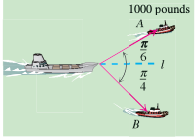
Suppose the forces from tugboat \(A\) and \(B\) are denoted by \(\mathbf F_{A}\) and \(\mathbf F_{B}\) respectively, so we have
\[\mathbf F_{A}=1000(\cos(\pi/6)\mathbf i+\sin(\pi/6)\mathbf j)=500\sqrt3\mathbf i+500\mathbf j \]Since tugboat forms a clockwise (instead of counterclockwise) angle with \(l\), we get
\[\mathbf F_{B}=\|\mathbf F_B\|(\cos(-\pi/4)\mathbf i+\sin(-\pi/4)\mathbf j)=\|\mathbf F_B\|\dfrac{\sqrt2}{2}\mathbf i-\|\mathbf F_B\|\dfrac{\sqrt2}{2}\mathbf j \]To pull the freighter along \(l\), the total force
\[\mathbf F_{A}+\mathbf F_B=\left(500\sqrt3+\|\mathbf F_B\|\dfrac{\sqrt2}{2}\right)\mathbf i+\left(500-\|\mathbf F_B\|\dfrac{\sqrt2}{2}\right)\mathbf j \]must have zero \(\mathbf j\) component, therefore
\[500-\|\mathbf F_B\|\dfrac{\sqrt2}{2}=0\Rightarrow\|\mathbf F_B\|=\dfrac{500}{\sqrt2/2}=500\sqrt2 \]The unit would be pounds.
-
(\(\S11.2\), 27) Three children tug on a ball located at \(O\). One child pulls with a force of 20 pounds in the direction of the negative y axis. Another child pulls with a force of 100 pounds at an angle of \(\pi/3\) with the positive \(x\) axis. If the total force exerted on the ball is to be \(\mathbf 0\), find the force \(\mathbf F\) with which the third child should pull and the tangent of the angle \(\theta\) between the positive \(x\) axis and the direction in which the third child should pull.
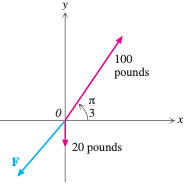
Assume \(\mathbf F=a\mathbf i+b\mathbf j\). We see the force in the first quadrant is
\[\mathbf F_1=100(\cos(\pi/3)\mathbf i+\sin(\pi/3)\mathbf j)=100(1/2\mathbf i+\sqrt3/2\mathbf j)=50\mathbf i+50\sqrt3\mathbf j \]and the force to the negative \(y\) axis is
\[\mathbf F_2=-20\mathbf j \]Since the total force should be \(\mathbf 0\), we have equation
\[\mathbf F+\mathbf F_1+\mathbf F_2=\mathbf 0\iff\begin{cases} a+50=0\\ b+50\sqrt3-20=0 \end{cases} \]From which we may solve
\[\mathbf F=(-50)\mathbf i+(20-50\sqrt3)\mathbf j \]Therefore
\[\|\mathbf F\|=\sqrt{(-50)^2+(20-50\sqrt3)^2} \]and
\[\theta=\cos^{-1}\left(\dfrac{\mathbf F\cdot\mathbf i}{\|\mathbf F\|\|\mathbf i\|}\right)=\cos^{-1}\left(\dfrac{-50}{\sqrt{(-50)^2+(20-50\sqrt3)^2}}\right) \]